

Historic Joinery
Creating Something New In Conversation With The Past
Where do you get mouldings that are unique to your building?
Or a door with a flat tangential arch?
That’s what historic joinery does.
It’s about creating what’s needed but can’t be bought off the shelf – making the new look old, so it feels as though it’s always been there.
Whether it’s a door, a staircase, or panelling within a listed home, each element is handmade in a way that honours the proportions, techniques and thinking of the original makers.
It’s craftsmanship that listens to the building before adding to it.
Every line and joint is designed to belong.
A Deep Understanding Of How Things Were Made
Looking back, my teens mattered most in shaping my work.
I’d spend hours in the Victoria & Albert Museum, watching and sketching. I’d walk around historic homes that had never been touched, taking every opportunity to handle old pieces of furniture, turning drawers upside down, studying how they were made.
That’s where I started to understand proportion and craftsmanship, and why those old pieces lasted the way they did.
That knowledge has shaped every piece of joinery I make.
I can hand-make everything. It doesn’t matter whether you can buy it or not. I can design it, make it, age it, develop it, and bring that sense of age back.
It could be windows, doors, floors or staircases for your listed building or period property. Anything that helps your space keep its heritage and heart.
I work alone in the workshop, but for bigger commissions, I have a trusted team of experts I can call upon.
Each project demands the same balance of precision, patience and a reverence for how things were first made.
For example, on the Titanic estate, I designed two new staircases, but each one had to belong to the building.
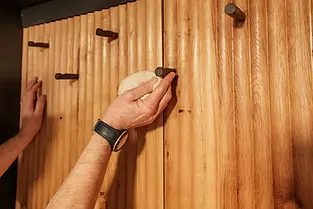
Every detail mattered – the height of the tread, the going of it, the carving on the new post – so you couldn’t tell where the old stops and the new begins.

The Challenges Of Getting It Right
When you own an old house or a historic building, there’s often one question behind every decision: where do you go for that?
Something unique that you can’t find anywhere else.
Something new that still needs to look old to fit within its setting.
Or a detail that has to be made properly, not just fixed together.
That’s when clients come to me.
They don’t want a near-match; they want authenticity.
Sometimes they’ve called joiners or carpenters, but the work never quite fits – the joints are nailed and screwed, the character smoothed away, the spirit lost.
Historic joinery demands a different kind of skill. One that respects the way old buildings were built and listens to the rhythm of their design.
Everything I make is done by hand, with tools that have been used for decades. Each piece echoes the building’s original features and meets the standards expected of historic properties.
Quality here is built, not bought; everything is designed and made from scratch from the finest materials.
It’s how new work gains the quiet authority of age and endures for generations.
"Step into my Aladdin's Cave of loveliness"
Inside The Workshop
When I’m working on a new piece, it always begins with looking and understanding.
If I’m in an old building, I’ll walk around with my sketchbook, studying the original mouldings and profiles – sketching what I see so I can carry those details into the new work.
It’s about getting into the head of the original makers: the tools they used, the intention behind every joint and curve, and how they thought when they built the house or the furniture within it.
In the workshop, that understanding turns into making.

Step into my Aladdin’s cave of loveliness – chisels, planes, oils, resins, and hand-made waxes in every shade. Bottles everywhere, like an old-fashioned chemist’s, ready to change the surface.
Everything you need to make, shape, colour, and finish timber so it looks as though it’s always been there.
Sometimes I’ll oxidise the surface in the way a hundred years would – and there are dozens of ways to do that – letting time and chemistry work together to bring depth and life to the wood.
It’s a way of recreating age so the new work fits seamlessly with its new home.


"I would like to thank Owen for the professional service he provided, replacing an old stained glass window. I found Owen to be such a kind, gentle man who clearly knows his craft exceptional well. My window was tricky but Owen made something that was tailor made and unique. The result is exceptional and oozes quality. I would highly recommend. Thank you Owen"
— G J in Chester
Get In Touch
Good joinery does more than fit a space – it becomes part of it.
You’ll have peace of mind knowing it’s been made properly, fits beautifully, and will endure for years to come.
If we can help you with your next commission, don’t hesitate to contact us.
Or explore more of our work in Antique Restoration and Bespoke Furniture.